

When the James Webb Space Telescope captures an image of a distant galaxy, it is not just looking far away — it is looking far back in time. Light travels at a finite speed, so the farther an object is, the older the light that reaches us. Some of the galaxies Webb has imaged existed only a few hundred million years after the Big Bang, more than 13 billion years ago. This guide explains the physics that make that feat possible and the remarkable engineering Webb uses to pull it off.
Table of Contents
Understanding how Webb sees ancient light requires grasping three connected ideas: the speed of light as a cosmic clock, the way the expanding universe stretches that light into the infrared spectrum, and why Webb’s design — from its gold-coated mirror to its tennis-court-sized sunshield — is purpose-built to capture exactly that stretched light.
Quick Answer
The James Webb Space Telescope sees ancient light because it detects infrared radiation — light whose wavelength has been stretched (redshifted) by the universe’s expansion over billions of years of travel. Light that originally left a young galaxy as ultraviolet or visible radiation arrives at Webb as infrared, and Webb’s gold-coated mirror and cooled instruments are tuned specifically to capture those wavelengths, allowing it to observe galaxies that existed only a few hundred million years after the Big Bang.
Light as a Time Machine: Why Distant Means Ancient
Light travels roughly 186,000 miles per second — fast, but not instantaneous. When you look at an object one light-year away, you see it as it was one year ago. Scale that up to billions of light-years and you are literally watching the past. The galaxies JWST images in the deep field emitted that light hundreds of millions to over 13 billion years ago, so we see them as young, newly formed structures — a snapshot of the early universe preserved in photons.
This is why astronomers prize the ability to look as far as possible: the most distant objects are also the oldest, and studying them reveals how galaxies, stars, and chemical elements first formed after the Big Bang.
Redshift: Why Ancient Light Arrives as Infrared
Here is the twist: the universe has been expanding the entire time that ancient light has been traveling. As space stretches, it stretches the light waves moving through it too, shifting them toward longer, redder wavelengths — a phenomenon astronomers call redshift. Light from a galaxy that formed only a few hundred million years after the Big Bang has been traveling and stretching for over 13 billion years. What began as ultraviolet or visible light arrives at Earth shifted deep into the infrared part of the spectrum.
The amount of stretching is described by a redshift value written as ‘z’. A higher z means more stretching and therefore a more distant, more ancient source. In May 2024, Webb confirmed the galaxy JADES-GS-z14-0 at a redshift of about 14.32, placing it less than 300 million years after the Big Bang. In 2025, a galaxy called MoM-z14 broke that record with a confirmed redshift of 14.44 — light from just 280 million years after the Big Bang, making it the most distant spectroscopically confirmed galaxy ever found.
Visible-light telescopes like Hubble struggle to detect these objects at all because the ancient light has shifted completely out of the visible range. JWST’s entire design is built around capturing the infrared wavelengths where that light now lives.
JWST’s Engineering: Built to Catch Invisible Light
Webb observes wavelengths from roughly 0.6 to 28 micrometers — from the edge of visible red light through the mid-infrared — using three main science instruments. NIRCam (Near-Infrared Camera) is the primary imager for distant galaxies, covering roughly 0.6 to 5 micrometers. MIRI (Mid-Infrared Instrument) probes deeper infrared wavelengths from about 5 to 28 micrometers and is especially useful for dust, cool objects, and exoplanet atmospheres. NIRSpec (Near-Infrared Spectrograph) splits light into spectra, letting astronomers precisely measure a galaxy’s redshift and chemical fingerprint.
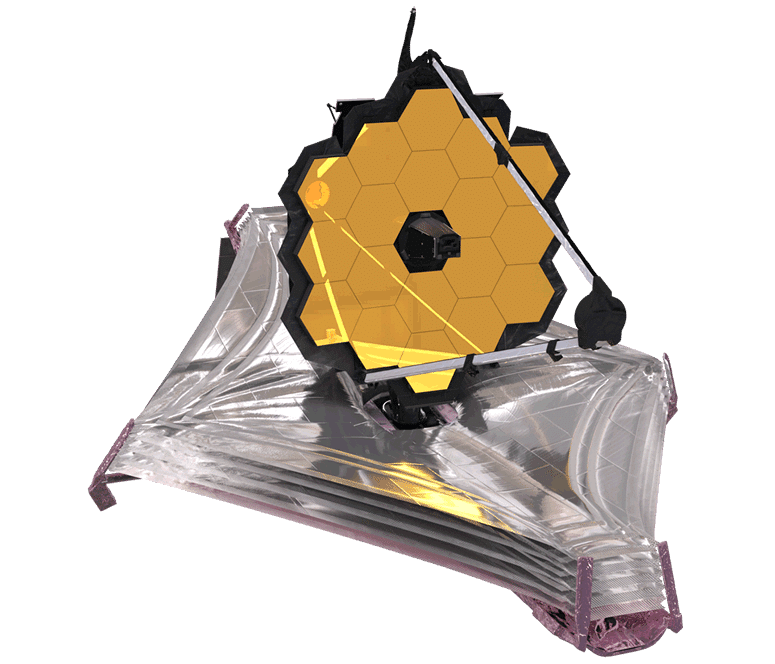
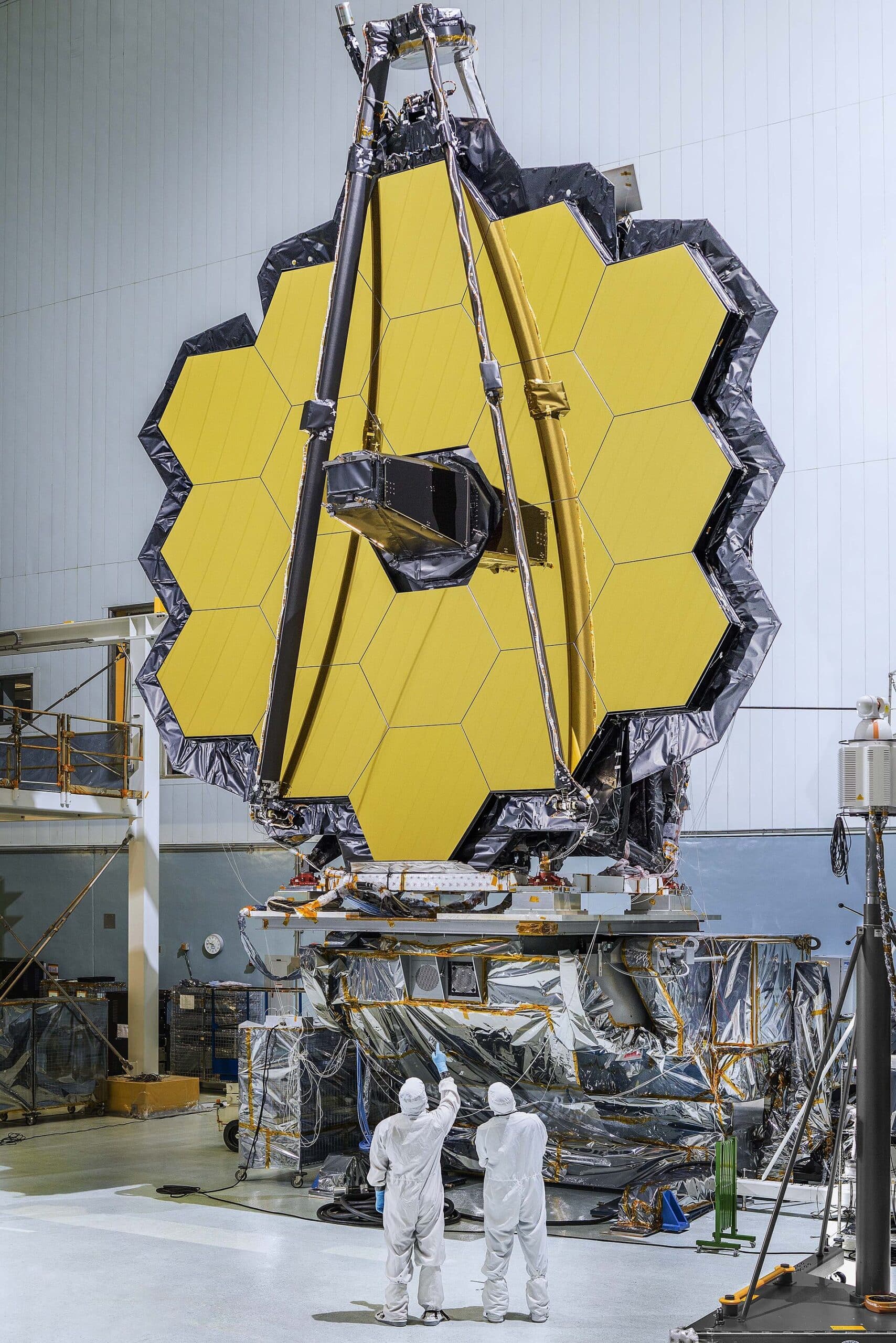
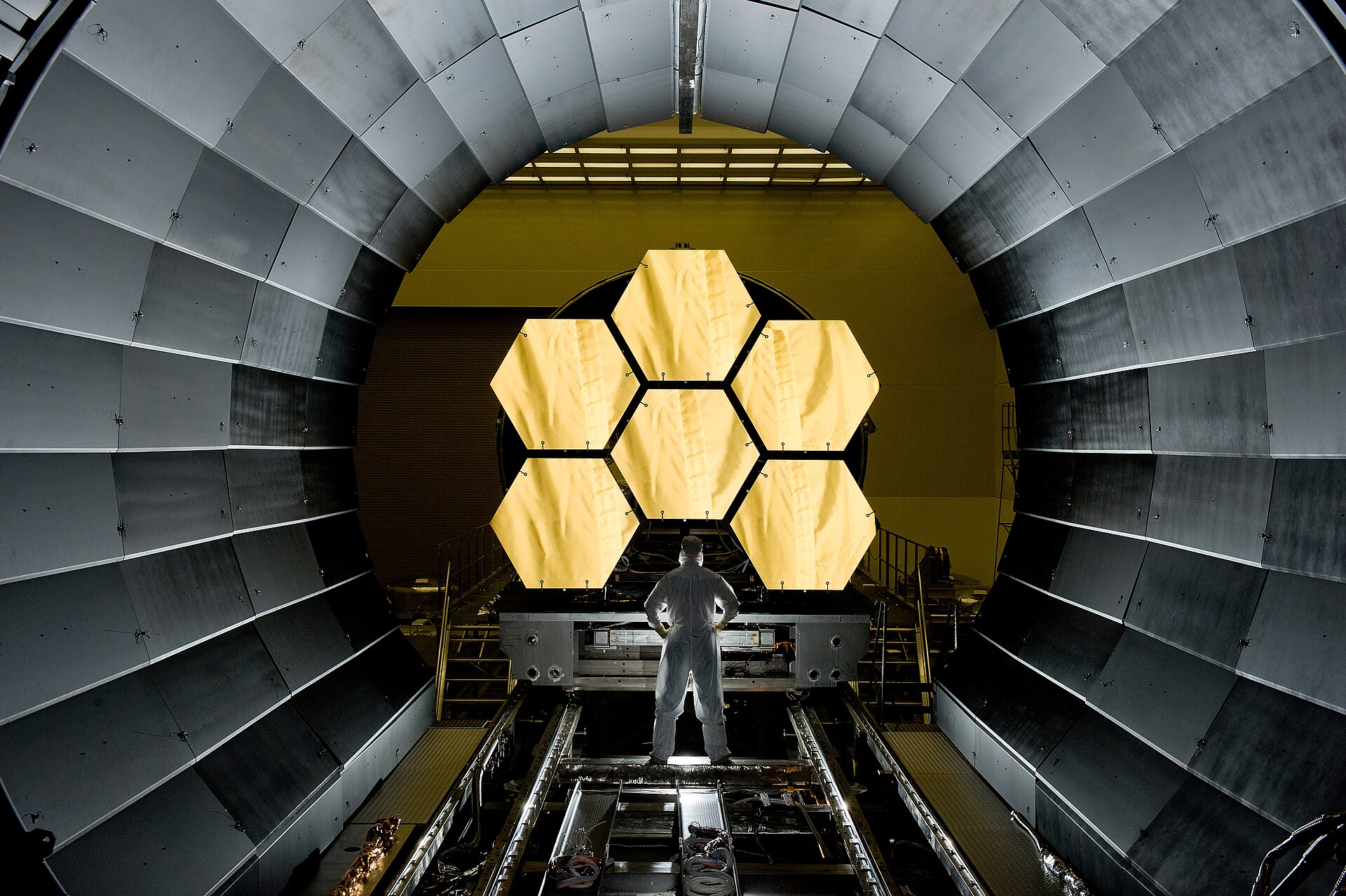
The primary mirror measures 6.5 meters (about 21 feet) across — roughly six times larger in collecting area than Hubble’s — and is made of 18 hexagonal beryllium segments, each coated with a microscopically thin layer of gold. Gold reflects infrared light exceptionally well, and the total gold used across all 18 segments weighs roughly as much as a golf ball. The segments fold up for launch and then unfurl and align to nanometer-level precision in space.
Because infrared means heat, Webb itself must be kept extremely cold — otherwise the telescope would detect its own warmth and be blinded. The solution is a five-layer sunshield approximately the size of a tennis court, which blocks heat from the Sun, Earth, and Moon simultaneously. Webb orbits the second Lagrange point (L2), a gravitationally stable location about 1 million miles from Earth, where the sunshield can permanently face the Sun and keep the mirror and instruments chilled to around -233°C (-387°F). Webb launched on December 25, 2021, aboard an Ariane 5 rocket and reached its L2 orbit about a month later.
What Webb Has Actually Seen at Cosmic Dawn
JWST’s observations of the early universe have repeatedly surprised astronomers. The most distant confirmed galaxies — including JADES-GS-z14-0 and MoM-z14 — existed only 280–300 million years after the Big Bang, far earlier than most telescopes could probe. These galaxies are often unexpectedly bright and massive for their age, suggesting star formation in the early universe happened faster and more vigorously than models predicted.
Early galaxies also look nothing like the spirals and ellipticals familiar today. JWST imaging shows many were flat and elongated — described by researchers as resembling surfboards and pool noodles. Webb has also begun probing the Era of Reionization, the period when the first stars ionized the hydrogen gas filling the universe. Infrared spectroscopy from NIRSpec detects the chemical fingerprints of oxygen and hydrogen in these ancient galaxies — evidence of multiple generations of massive stars that had already lived and died within the universe’s first few hundred million years.
Common Misconceptions About JWST
JWST is not simply a more powerful Hubble. The two telescopes operate at fundamentally different wavelengths. Hubble primarily sees in ultraviolet and visible light from an orbit about 340 miles above Earth; Webb sees in infrared from a position about 1 million miles away. They complement each other rather than one replacing the other, and are often pointed at the same targets to combine their strengths.
Another common confusion: Webb is not showing us what distant galaxies look like now. The galaxy MoM-z14 appeared that way 13.5 billion years ago. Its present-day state is unknowable through any telescope we have — that light has not yet reached us. What Webb provides is a fossil record of the early universe, frozen in photons that have been traveling since before our solar system existed.
Finally, Webb’s infrared capability serves science much closer to home. The same instruments that peer to cosmic dawn can also see through dust clouds in nearby star-forming regions, probe the atmospheres of exoplanets, and reveal fine detail in our solar system’s outer planets — making JWST a versatile tool for all of astronomy, not just cosmologists chasing the Big Bang.
Explore more: Explore more space articles.
James Webb Space Telescope FAQs
What is redshift and why does it matter for JWST?
Redshift is the stretching of light to longer (redder) wavelengths caused by the expansion of the universe. As ancient light travels billions of years, it shifts out of the visible spectrum and into the infrared. Since JWST is built to detect infrared light, redshift is precisely what makes it capable of seeing extremely distant, ancient galaxies — the higher the redshift value, the farther back in time Webb is looking.
What is the most distant object JWST has confirmed?
As of 2025, the most distant spectroscopically confirmed galaxy is MoM-z14, with a redshift of 14.44. Its light left the galaxy just about 280 million years after the Big Bang. The previous record holder, JADES-GS-z14-0, was confirmed in May 2024 at a redshift of about 14.32, placing it less than 300 million years after the Big Bang. Webb has broken its own distance record multiple times since beginning science operations.
How is JWST different from the Hubble Space Telescope?
Hubble primarily observes in ultraviolet and visible light from an orbit roughly 340 miles above Earth. JWST observes in infrared from a position about 1 million miles from Earth at the L2 Lagrange point. Webb’s primary mirror is roughly six times larger in collecting area than Hubble’s, and its instruments must be kept near absolute zero to detect faint infrared signals. Both telescopes are still operational and are frequently used together to study the same targets.
Make Your Digital Life Better
More practical tech how-tos, tool picks, and guides to upgrade your everyday digital life. More on GTWebs.
Photo: NASA / Public domain, via Wikimedia Commons.