

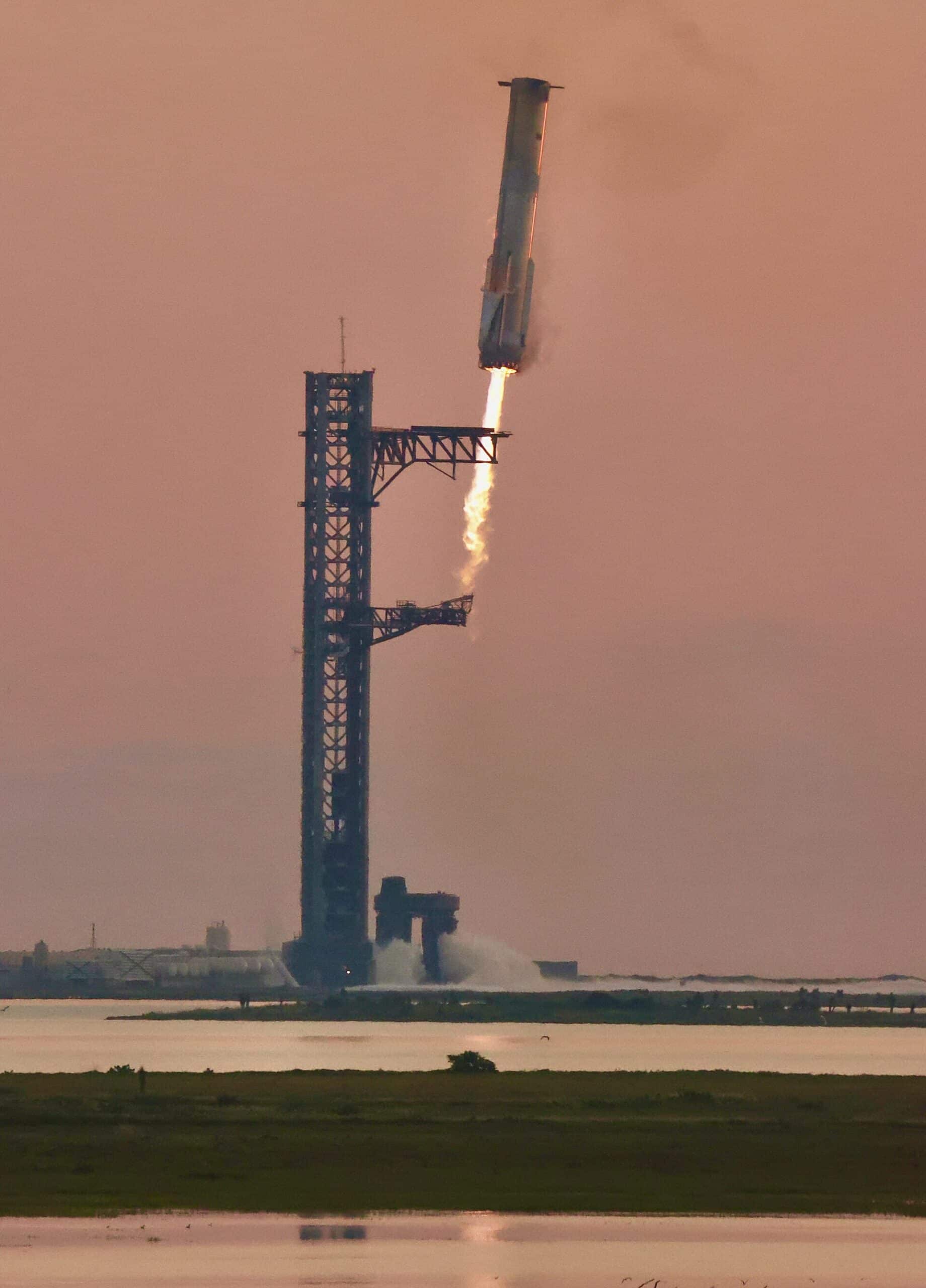
On October 13, 2024, SpaceX did something that had never been done in the history of spaceflight: it caught a 71-meter rocket booster mid-air using a pair of giant mechanical arms bolted to a launch tower. The maneuver, pulled off on the very first attempt during Starship’s fifth test flight, looked more like a scene from a science fiction film than an engineering milestone.
Table of Contents
The system — nicknamed ‘Mechazilla’ after the movie monster Mechagodzilla — is central to SpaceX’s vision for rapid rocket reusability. The catch arms, informally called ‘chopsticks,’ are designed to grab the returning Super Heavy booster within seconds of it hovering back to the pad, then lower it directly onto the launch mount for refueling and relaunch. Here’s exactly how that sequence works, why SpaceX chose arms over landing legs, and what the track record looks like so far.
Quick Answer
The Super Heavy booster separates from the Starship upper stage, performs a flip and boostback burn to reverse course, then descends back to the launch pad under thrust from a subset of its 33 Raptor engines. As it approaches the tower, two massive ‘chopstick’ arms — each roughly 36 meters long — close around the booster at hard points near its grid fins and hold it in place. Hydraulic systems absorb the impact. The entire catch happens roughly seven minutes after liftoff, and if anything is out of tolerance the booster automatically diverts to a water splashdown instead.
The Catch Sequence Step by Step
Step 1 — Separation and flip: About two to three minutes after launch, Super Heavy separates from the Starship upper stage and performs a dramatic flip maneuver, reorienting itself engine-first toward the ground. It then fires a subset of its Raptor engines in a ‘boostback burn’ that reverses its velocity and sends it back toward the launch site.
Step 2 — Grid fin steering: As the booster falls back through the atmosphere, four large grid fins deploy near its top. These metal panels act like aerodynamic rudders, steering the vehicle and bleeding off speed through drag. They handle most of the coarse directional corrections during the high-altitude phase of descent.
Step 3 — Landing burn: With the pad growing close, the booster ignites its engines again to decelerate from hundreds of miles per hour to near-zero. During Flight 5, SpaceX used 13 engines for the main landing burn before throttling down to just 3 in the final seconds before capture — threading the needle between too fast and a hard crash.
Step 4 — Precision approach: Onboard flight computers using GPS, inertial navigation, and sensor data from the tower’s own radar and optical tracking systems continuously compute the booster’s position and velocity. The booster must arrive within roughly one to two meters of center horizontally — an extraordinary margin for a vehicle that just flew to the edge of space and back.
Step 5 — The catch: The two chopstick arms on the tower, which had been held wide open, close in and grip the booster at structural hard points near its grid fins. Hydraulic systems built into the arm mechanism absorb the kinetic energy of the grab. The booster is then lowered directly onto the launch mount below. If any flight parameter — trajectory, velocity, or vehicle attitude — falls outside predetermined tolerances at any point during the approach, the flight computer cancels the catch automatically and the booster diverts to a controlled splashdown in the Gulf of Mexico.
Why Arms Instead of Landing Legs?
The most common question people ask: why not just land the booster on legs like the Falcon 9 does? SpaceX made a deliberate engineering trade-off here. Landing legs capable of supporting a Super Heavy booster — which stands 71 meters tall and weighs roughly 275 metric tons dry — would add enormous mass to the vehicle. That mass comes directly out of payload capacity to orbit, making every mission more expensive.
The chopstick system shifts that structural weight off the rocket and onto the ground, where it can be as heavy and robust as needed without penalty. And because the arms deliver the booster directly back onto the launch mount, SpaceX can refuel and re-launch far faster than if technicians had to haul the booster from a landing pad on a transporter erector. SpaceX’s long-term goal is turnaround times measured in hours, eventually enabling the kind of launch cadence needed for Mars missions. The Mechazilla tower itself stands approximately 146 meters (roughly 480 feet) tall — taller than the Starship vehicle it services — so it has the reach to grab the booster well above ground level and guide it down.
Tips and Common Misconceptions
Mechazilla doesn’t always attempt a catch. SpaceX runs automated health checks on the arm hardware before and during every flight. On Flight 6 in November 2024, one of those checks flagged a concern and the catch was called off mid-flight. The booster executed a preplanned diversion and splashed down safely in the Gulf of Mexico. The abort system is working as designed — a water landing is a fine outcome, not a failure.
The catch record through mid-2025 stands at three successes: Flight 5 (October 13, 2024, first-ever attempt), Flight 7 (January 16, 2025), and Flight 8 (March 6, 2025). Flight 9 in May 2025 marked the first-ever re-flight of a Super Heavy booster, but it was lost when structural failure during the landing burn caused the vehicle to break apart over the Gulf of Mexico before any catch could be attempted. SpaceX attributed the loss to higher-than-predicted aerodynamic forces that ruptured an internal propellant transfer tube.
Mechazilla only catches the booster, not the Starship upper stage. The two vehicles are separate. Upper stage recovery is a different problem SpaceX is still working through. Don’t confuse a successful booster catch with a fully successful Starship mission — Flights 7 and 8 both caught the booster cleanly but lost the upper stage to in-flight anomalies. The catch system itself, though, has worked every time it was actually attempted.
Explore more: More space exploration articles.
Mechazilla FAQs
What is Mechazilla?
Mechazilla is the nickname for the catch arm system on SpaceX’s Starship launch tower at Starbase in Boca Chica, Texas. The name is a play on Mechagodzilla. Its two ‘chopstick’ arms close around the returning Super Heavy booster mid-air and hold it in place, allowing it to be lowered directly onto the launch mount for rapid reuse.
How many times has Mechazilla successfully caught a booster?
Through mid-2025, Mechazilla completed three successful catches: Starship Flight 5 (October 13, 2024 — the first-ever attempt), Flight 7 (January 16, 2025), and Flight 8 (March 6, 2025). One catch attempt was aborted on Flight 6 due to a hardware health check, with the booster safely splashing down instead. Flight 9’s booster was destroyed when structural failure during its landing burn caused it to break apart over the Gulf of Mexico before a catch could be attempted.
What happens if the booster misses the arms?
The flight computer monitors trajectory, velocity, and vehicle attitude in real time throughout the descent. If any parameter strays outside pre-set tolerances, the catch is automatically cancelled and the booster redirects to a controlled splashdown in the Gulf of Mexico. SpaceX demonstrated this abort capability on Flight 6, when the booster diverted safely to water after an automated check flagged a concern with the arm hardware.
Make Your Digital Life Better
More practical tech how-tos, tool picks, and guides to upgrade your everyday digital life. More on GTWebs.
Photo: Steve Jurvetson / CC BY 2.0, via Wikimedia Commons.