


Every time a loaf of bread puffs up in the oven, a microscopic organism is doing the heavy lifting. Yeast — a single-celled fungus called Saccharomyces cerevisiae — consumes sugars in your dough and exhales carbon dioxide gas, inflating countless tiny bubbles that transform a dense lump of flour and water into an airy, chewy loaf. Understanding the biology behind this process doesn’t just satisfy curiosity; it makes you a better baker.
Table of Contents
This guide breaks down exactly what happens inside your dough from the moment yeast meets flour to the instant the oven sets the crumb. You’ll learn the chemistry of fermentation, why temperature and gluten are so critical, how the three main types of commercial yeast differ, and which common mistakes quietly sabotage your rise.
Quick Answer
Yeast eats sugars in the dough and produces carbon dioxide gas and ethanol through a process called anaerobic fermentation. The CO2 gets trapped in a stretchy network of gluten proteins, inflating the dough like a balloon. Heat from the oven kills the yeast, evaporates the alcohol, and locks the gluten structure in its risen shape — giving bread its characteristic open, airy crumb.
The Fermentation Reaction: What’s Actually Happening in Your Dough
Baker’s yeast — Saccharomyces cerevisiae, the same organism used in brewing beer and fermenting wine — is a facultative anaerobe, meaning it can respire with or without oxygen. Inside a dense ball of dough, oxygen quickly runs out. Yeast then switches to anaerobic fermentation, breaking down simple sugars (glucose, sucrose, and maltose released from flour starch) into two byproducts: carbon dioxide and ethanol. The simplified equation is: C₆H₁₂O₆ → 2 C₂H₅OH + 2 CO₂.
Carbon dioxide is the real workhorse of rising. Produced continuously during fermentation, the gas has nowhere to escape because of the gluten network surrounding it — so it accumulates as tiny bubbles, expanding the dough from the inside. Ethanol, the alcohol byproduct, plays a secondary role: it mostly evaporates during baking, but the traces left behind during a slow fermentation contribute noticeably to a loaf’s depth of flavor and slight tang.
Flour also contains native amylase enzymes that break down starch into the simpler sugars yeast can eat, so even an unsweetened dough provides adequate fuel. Adding a small amount of sugar or honey to a recipe gives yeast an early boost, but too much sugar can actually slow fermentation by drawing water away from yeast cells through osmotic pressure.
Why Gluten Is the Other Half of the Equation
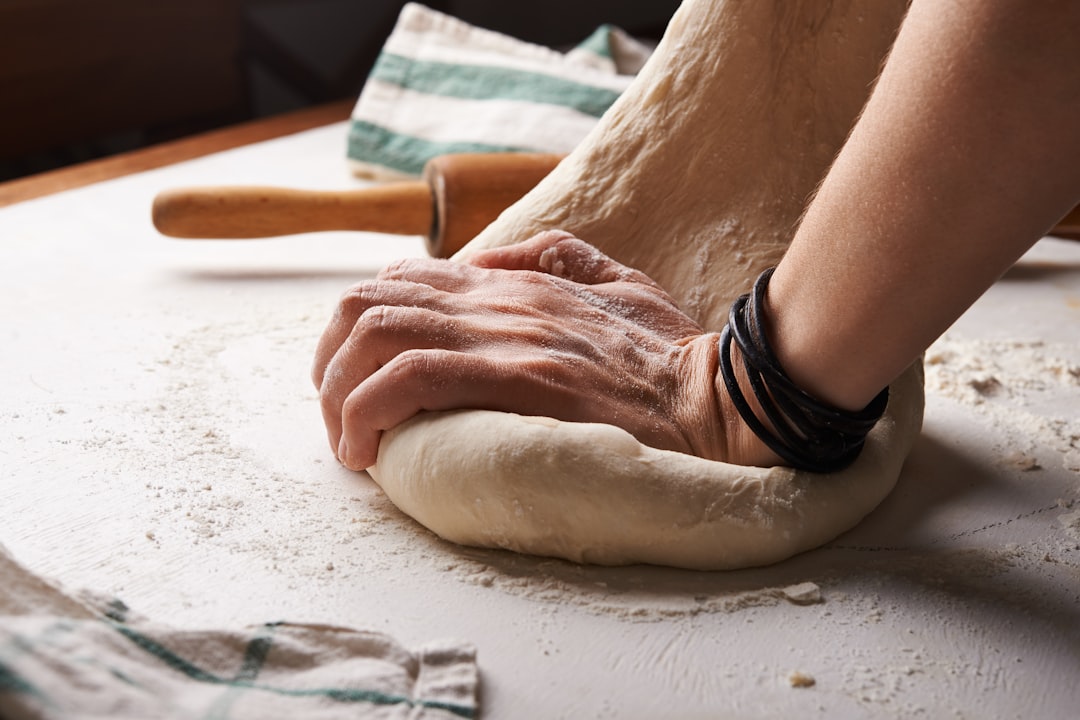
Fermentation alone won’t make bread rise if the dough can’t hold the gas. That’s gluten’s job. When flour and water are mixed and kneaded, two proteins — glutenin and gliadin — link together into an elastic, web-like network called gluten. Think of it as the walls of millions of tiny balloons: CO2 inflates each pocket, and the gluten stretches to accommodate it without letting the gas escape.
A poorly developed gluten network — from under-kneading, wrong flour, or adding too much fat or liquid too early — lets gas bubbles escape rather than accumulate, and the dough stays flat. This is why recipes ask you to knead until the dough is smooth and passes the windowpane test (stretching a small piece thin enough to see light through without tearing) before the first rise begins.
During baking, the oven’s heat causes the trapped CO2 and alcohol to expand further, giving the loaf one last burst of growth called oven spring. At around 140°F (60°C), yeast cells die. By roughly 160–180°F, the gluten proteins denature and set permanently, locking the crumb structure into its final, airy shape.
Temperature: The Dial That Controls Everything
Yeast is highly sensitive to temperature. Below about 70°F, fermentation slows dramatically — which is actually useful for developing flavor in a long cold proof, but impractical if you want bread in a few hours. The sweet spot for an active room-temperature rise is roughly 75–80°F. At around 100–110°F, yeast activity peaks, which is why many recipes call for ‘warm water’ when blooming active dry yeast.
Above 140°F, yeast dies — so water that’s too hot will kill your yeast before fermentation even starts, leaving you with a dense, flat loaf. Cold fermentation (proofing in the refrigerator at around 38–40°F) slows yeast metabolism to a crawl over 12–24 hours, allowing enzymes and slower-acting bacteria to produce a richer, more complex flavor with subtle acidity — the technique behind most artisan sourdoughs and overnight bread recipes.
Active Dry, Instant, or Fresh Yeast — What’s the Difference?
Active dry yeast is the most common grocery-store variety. It’s granulated and dehydrated, and it must be dissolved (‘bloomed’) in warm water before mixing into dough to rehydrate the dormant cells. Instant yeast (also sold as rapid-rise or bread machine yeast) is milled into finer granules with more live cells per gram and can be mixed directly into dry ingredients without pre-dissolving — it’s faster and generally preferred by home bakers for everyday loaves. Fresh yeast, sold in soft compressed cakes in the refrigerated section, has a much shorter shelf life (roughly two weeks) but is favored by professional bakers because it dissolves easily and produces a notably strong, rapid rise with rich flavor. For most home baking, active dry and instant yeast are interchangeable in the same amounts.
Tips and Common Mistakes
Check your water temperature before adding yeast — a kitchen thermometer takes the guesswork out and avoids the most common cause of failed dough. Aim for lukewarm, never hot. If in doubt, cooler is safer than hotter.
Don’t rush the rise. A faster rise at high temperature produces bread that tastes flat. A slower rise at a lower temperature gives yeast more time to develop flavorful compounds. If you have time, cold-proofing overnight in the fridge almost always rewards you with better flavor.
Make sure your gluten is well-developed before fermentation begins. Under-kneaded dough can’t trap CO2 effectively regardless of how active your yeast is. Knead until the dough is smooth and elastic, and resist the urge to add extra flour if it feels sticky — a wetter dough generally produces a more open crumb.
Keep salt away from yeast during mixing. Salt is necessary in bread (it strengthens gluten and controls fermentation rate), but direct contact with dry yeast can damage yeast cells before they’re distributed through the dough. Add salt to the flour first, then introduce the yeast separately.
Test old yeast before committing to a full recipe. Dissolve a small amount in warm water with a pinch of sugar — within about ten minutes it should foam noticeably. If it doesn’t, the yeast is too old and won’t leaven your bread.
Explore more: Explore more Science articles.
Yeast fermentation in bread FAQs
Can you make bread rise without yeast?
Yes. Chemical leaveners like baking soda and baking powder release CO2 through acid-base reactions rather than fermentation, producing a quick rise without any waiting. Sourdough starter uses wild yeast and bacteria naturally present in flour and the environment rather than commercial yeast. Each method produces CO2 but with different flavor profiles and textures — commercial yeast gives the most predictable, neutral-flavored rise.
Why does bread smell like alcohol while proofing?
That’s ethanol, the other byproduct of yeast fermentation. As yeast breaks down sugars, it releases both CO2 and alcohol. The alcoholic smell is especially noticeable during a long, slow proof or with a sourdough starter. The alcohol mostly evaporates during baking, leaving behind flavor compounds rather than a boozy taste.
Why did my dough rise but then collapse?
Over-proofing. When yeast has consumed most of the available sugars, CO2 production slows but the gas already in the dough continues to stretch the gluten. Eventually the gluten network weakens and can no longer support the structure, causing the dough to collapse. Punch down over-proofed dough gently, reshape it, and give it a short second proof to rescue a salvageable loaf.
Make Your Digital Life Better
More practical tech how-tos, tool picks, and guides to upgrade your everyday digital life. More on GTWebs.
Photo: Ahmed Emad H / CC BY-SA 4.0, via Wikimedia Commons.