

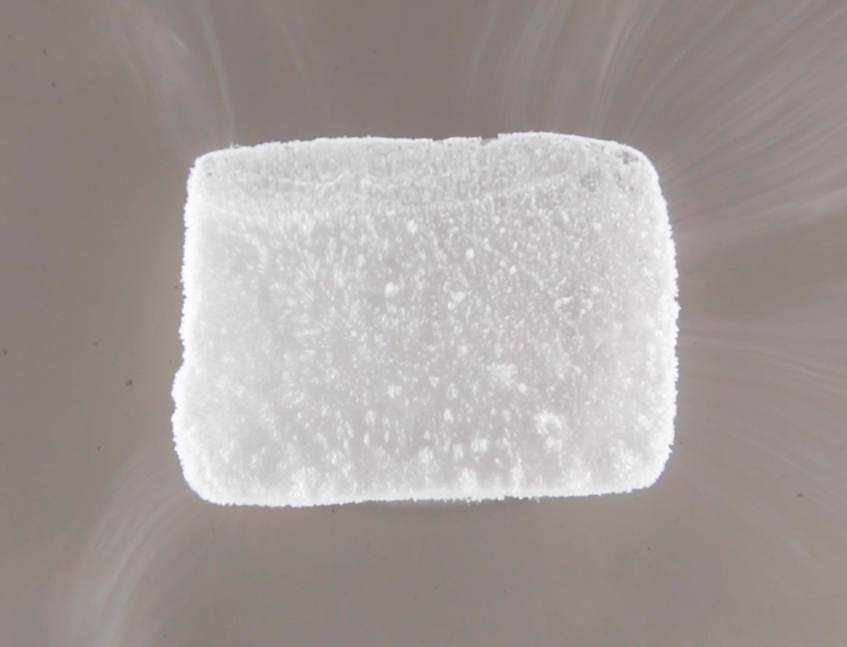
Drop a chunk of dry ice in warm water and you get a thick, tumbling fog spilling over the sides — no puddle, no drips, none of the slow wet melt you’d get from a regular ice cube. That’s not a party trick gimmick, it’s basic physics: dry ice is frozen carbon dioxide (CO2), and at the air pressure we live in, CO2 simply cannot exist as a liquid.
Table of Contents
This guide breaks down exactly what’s happening at the molecular level, where the fog you see actually comes from (it’s a more interesting answer than most people assume), and what that means for how you should actually handle the stuff.

Quick Answer
Dry ice skips the liquid phase entirely because normal atmospheric pressure is too low for CO2 to exist as a liquid — it goes directly from solid to gas, a process called sublimation. The thick white ‘fog’ you see when dry ice is dropped into water isn’t the CO2 gas itself (which is invisible); it’s real water. Water evaporates off the surrounding water into the intensely cold CO2 bubbles forming around the dry ice, then instantly condenses back into tiny liquid droplets inside those bubbles, which carry the fog up and out as they burst at the surface.
Why CO2 Can’t Melt at Normal Pressure
Every substance has a ‘triple point’ — a specific combination of temperature and pressure at which its solid, liquid, and gas phases can all exist at once. Below the triple point’s pressure, a liquid phase isn’t possible at all, no matter the temperature. For water, the triple point pressure is very low (well below normal atmospheric pressure), which is why ice melts into liquid water so easily on a normal day.
Carbon dioxide’s triple point sits at roughly 5.1 atmospheres of pressure and about -56.6°C (-69.9°F). Regular atmospheric pressure is only 1 atmosphere — far below that threshold. Since there’s no pressure ‘window’ for liquid CO2 to exist at 1 atmosphere, solid CO2 (dry ice) has only one place to go when it warms up: straight to gas. That’s sublimation, and it happens at around -78.5°C (-109.2°F) at sea-level pressure.
This is also why CO2 fire extinguishers and soda cartridges store carbon dioxide as a pressurized liquid — cranking up the pressure past that 5.1-atmosphere threshold is the only way to make liquid CO2 exist in the first place.
So Where Does the Fog Actually Come From?
The gas coming directly off dry ice is pure CO2, and pure CO2 gas is completely colorless. If you sublimate dry ice in a bone-dry room with no water nearby, you’ll see only a faint wisp, if that — there’s simply not enough moisture around to make a dense cloud.
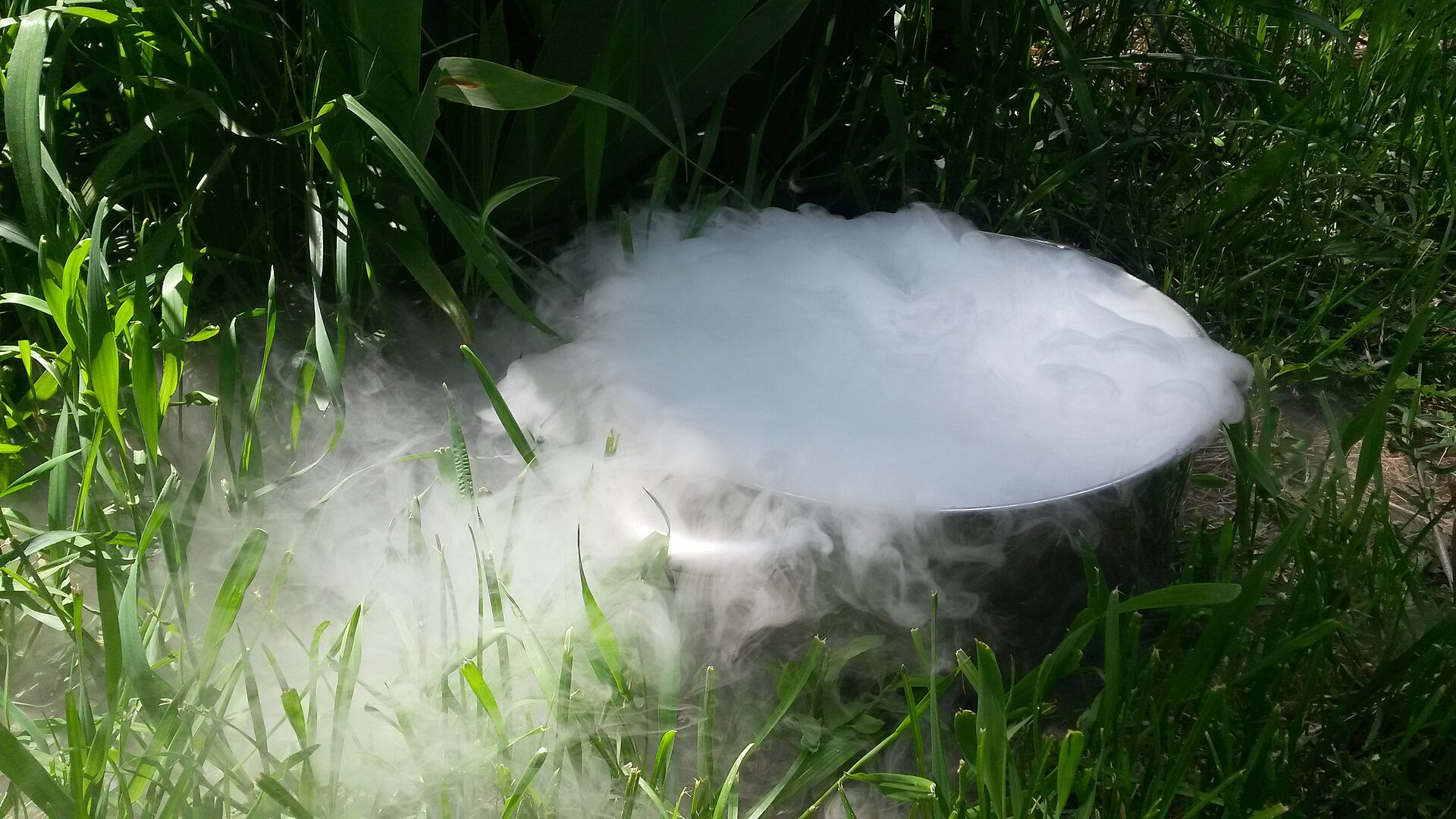
The thick, dramatic fog people associate with dry ice — the kind used in Halloween decorations and stage effects — comes from dropping it into water, and research into the effect has shown the water in that fog is drawn from the water in the container, not from humidity in the air. As the dry ice sublimates, it forms bubbles of CO2 gas at the water’s surface. Because that gas is close to -78.5°C, water immediately evaporates off the surrounding liquid and into the bubble, then just as immediately condenses back into a swarm of tiny liquid droplets inside the still-forming bubble — high-speed video of the process shows bubbles already cloudy with fog before they even separate from the ice. As each bubble empties of water vapor, more water evaporates in to replace it, so the cycle keeps feeding itself. When those cloud-filled bubbles reach the surface and burst, the fog spills out and rolls across the surrounding surface.
This is also why the fog rolls downward and pools along the floor or table instead of rising like steam: the CO2 gas carrying those droplets is significantly denser than the surrounding air, so it sinks and spreads outward in that classic low-lying ‘spooky fog’ layer.
Tips / Common Mistakes
Never seal dry ice in an airtight container. As it sublimates it releases a large volume of CO2 gas, and pressure can build up fast enough to rupture or explode the container. Use a container with a loose-fitting lid or some ventilation.
Always handle it with insulated gloves or tongs. At around -78.5°C, direct skin contact can cause frostbite-like burns within seconds.
Don’t use it to fog a small, unventilated room. Because the CO2 gas sinks and can displace breathable air near the floor, dry ice fog in an enclosed space is a genuine suffocation risk — always keep the area ventilated, especially at floor level.
For the biggest, longest-lasting fog effect (a common ask for Halloween decorations or stage effects), drop chunks into hot rather than cold water. Warmer water speeds up sublimation and evaporates into the CO2 bubbles faster, feeding the condensation cycle that produces the cloud — which is also why fog machines and haunted-house setups almost always use a water bath rather than bare dry ice.
Explore more: more science explainers.
Dry ice sublimation FAQs
Does dry ice ever melt into a liquid?
Not at normal atmospheric pressure. Liquid CO2 only exists above about 5.1 atmospheres of pressure, so at sea-level pressure dry ice sublimates directly from solid to gas instead of melting.
Does the dry ice fog come from the air or the water?
When dry ice is dropped in water, the fog is made of real water pulled from that water — it evaporates into the freezing-cold CO2 bubbles forming at the dry ice and instantly condenses into droplets, which the bubbles carry to the surface. It’s not condensed humidity from the surrounding air.
Is the fog from dry ice dangerous to breathe?
In a well-ventilated area it’s generally fine, but CO2 gas is heavier than air and can build up in low, enclosed spaces, so avoid using dry ice fog in small, sealed rooms without ventilation.
How cold is dry ice?
Dry ice sublimates at about -78.5°C (-109.2°F) at normal atmospheric pressure, making it roughly 100°F colder than a regular ice cube.
Why does dry ice fog sink instead of rise?
The CO2 gas released is denser than the surrounding air, so it sinks and spreads along the ground rather than rising the way steam does.
Make Your Digital Life Better
More practical tech how-tos, tool picks, and guides to upgrade your everyday digital life. More on GTWebs.
Want web tips in your inbox? Subscribe to the free newsletter.
Photo: KarolinaHalatek / CC BY-SA 4.0, via Wikimedia Commons.