

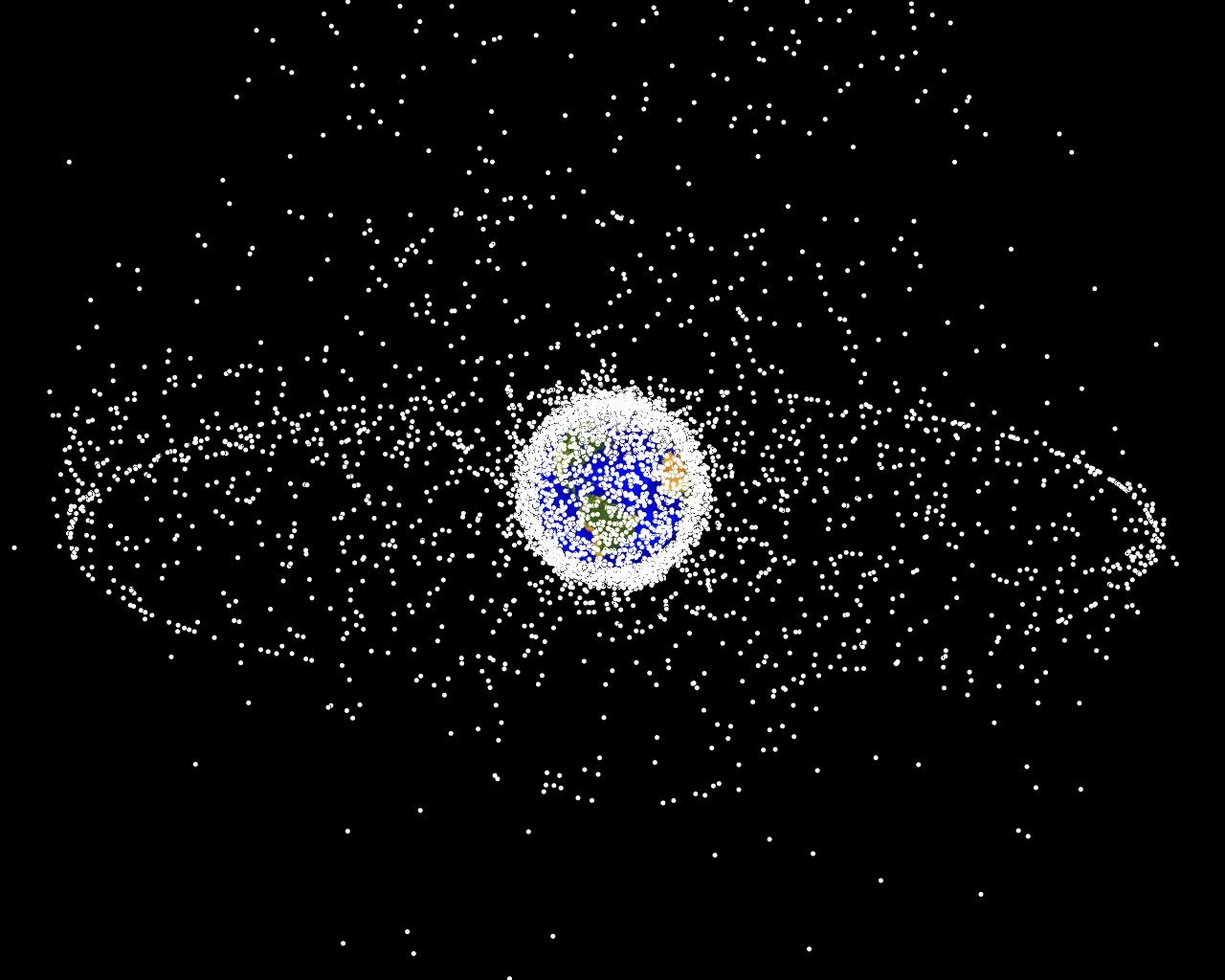
There are roughly 40,000 tracked objects circling Earth right now — dead satellites, spent rocket stages, and collision fragments — plus an estimated 130 million pieces of debris too small to track individually but fast enough to punch through a spacecraft hull. This isn’t just a cleanliness problem. Left unchecked, it could trigger a chain reaction that makes key orbital zones permanently inaccessible to humanity. That scenario has a name: the Kessler Syndrome.
Table of Contents
This article breaks down exactly what the Kessler Syndrome is, what the latest data says about how close we are, which orbits face the highest risk, and what space agencies and private companies are doing to prevent it — including the world’s first active debris removal mission, ClearSpace-1, currently targeting launch in 2029.
Quick Answer
The Kessler Syndrome is a self-sustaining cascade of satellite and debris collisions in low Earth orbit (LEO): one collision creates thousands of fragments, those fragments collide with other objects, generating even more fragments, until the density of debris makes the orbital zone effectively unusable. ESA’s 2025 Space Environment Report confirms that even without any new launches, debris populations in key orbital bands are already growing — but a full runaway cascade would unfold over decades to centuries, not overnight.
How the Cascade Mechanism Works
NASA scientists Donald J. Kessler and Burton G. Cour-Palais first described this risk in a 1978 paper, ‘Collision Frequency of Artificial Satellites: The Creation of a Debris Belt.’ They demonstrated that unlike asteroid collisions — which take billions of years to compound — the same physics would play out in LEO on a timescale of mere decades.
The cascade works like this: two objects collide at orbital speeds of roughly 17,500 mph (28,000 km/h). Each collision doesn’t just destroy both objects — it shatters them into hundreds or thousands of new fragments. Each fragment now has its own orbit and its own collision probability. More fragments mean a higher chance of more collisions, which create more fragments. Past a critical density threshold, this process becomes self-sustaining even if every nation on Earth stopped launching tomorrow.
The 2009 collision between the active Iridium 33 satellite and the defunct Russian Cosmos 2251 over Siberia was the first major catalogued satellite-on-satellite collision. It produced over 2,000 trackable debris pieces — and countless smaller ones below the detection threshold of ground-based radar. That single event offered a preview of cascade dynamics at a small scale.
How Bad Is the Debris Problem Right Now?
According to ESA’s Space Environment Report 2025, approximately 40,000 objects are currently tracked in Earth orbit, of which around 11,000 are active payloads. But tracking only captures part of the picture. Estimates put the number of debris pieces larger than 1 cm — large enough to catastrophically damage a satellite on impact — at over 1.2 million. Objects larger than 10 cm number more than 50,000.
A stability model using March 2025 population data found that the current debris population already exceeds the unstable threshold at all altitudes between 400 km and 1,000 km, and exceeds the runaway threshold at nearly all altitudes between 520 km and 1,000 km. That range includes the altitudes where SpaceX’s Starlink constellation operates (~550 km) and where the large defunct ESA satellite Envisat drifts uncontrolled at ~785 km. The ESA report confirmed that 2024 saw net growth in debris populations despite mitigation efforts.
It is important to note what ‘unstable’ means here: it means debris would continue growing in those bands even with no new launches, not that a catastrophic cascade is imminent. The most cautious scientific assessments place a full closure of major orbital zones on timescales of decades to centuries, and affecting specific bands rather than all of LEO simultaneously.
What Is Being Done to Prevent It?
Mitigation rules have tightened significantly. The Interagency Space Debris Coordination Committee (IADC) established guidelines in 2002 requiring satellites to deorbit within 25 years of mission completion. In 2022, the U.S. Federal Communications Commission replaced that with a stricter 5-year deorbit rule for LEO satellites, and ESA adopted the same standard. SpaceX designs its Starlink satellites to autonomously avoid collisions using onboard propulsion and live tracking data.
Rules, however, do nothing about the debris already up there. That is where active debris removal (ADR) comes in. ESA partnered with Swiss startup ClearSpace to develop ClearSpace-1, the world’s first dedicated debris removal mission, targeting launch in 2029. The mission’s original target — a Vega Secondary Payload Adapter (VESPA) left in orbit in 2013 — was changed in April 2024 after that object was struck by debris in August 2023 and its safety profile changed. ClearSpace-1 will now target PROBA-1, a 95 kg ESA Earth-observation satellite launched in 2001 that has long outlived its mission. The spacecraft will use a four-armed robotic grabber to capture PROBA-1 and drag it into a destructive atmospheric reentry.
Common Misconceptions About the Kessler Syndrome
The Kessler Syndrome is not a sudden overnight catastrophe. The cascade, if triggered in today’s most congested orbital bands, would unfold over decades — gradual enough to potentially detect and slow, but severe enough to permanently foreclose certain altitudes if ignored long enough.
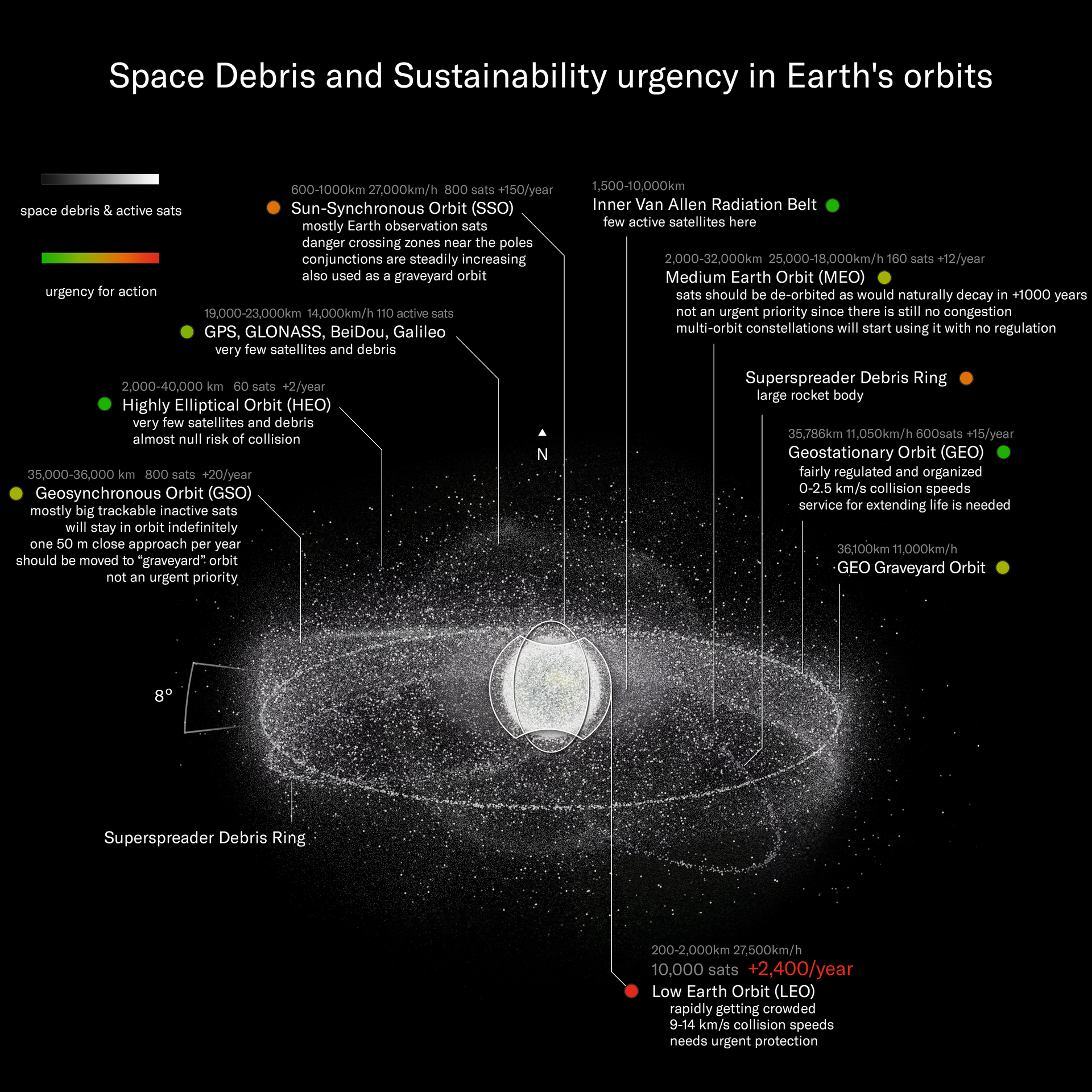
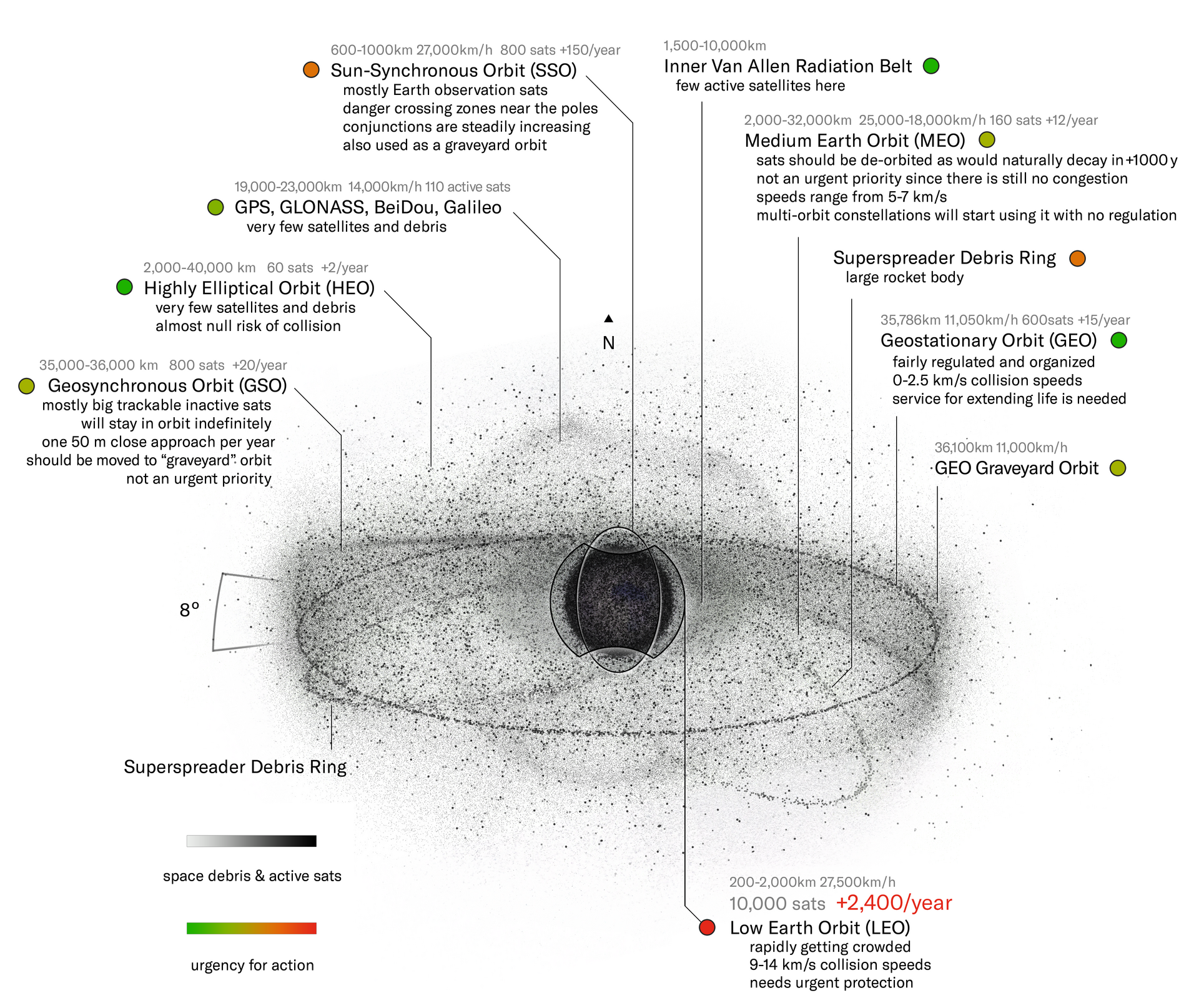
Not all orbits carry equal risk. The danger is concentrated in LEO, roughly 300–2,000 km altitude, where object density is highest and debris lingers longest before atmospheric drag pulls it down. Geostationary orbit at ~35,786 km has its own crowding problems, but debris there can remain for thousands of years and objects are far more spread out.
Small debris is the hardest part of the problem. Objects under 10 cm cannot be individually tracked by ground-based radar, yet a 1 cm fragment traveling at orbital speed carries the kinetic energy of a hand grenade. Collision avoidance works only for tracked objects — the millions of sub-10 cm pieces are unavoidable today.
Compliance with deorbit rules alone will not solve the problem. The roughly 130 million pieces of existing debris won’t deorbit themselves on a useful timescale. Without active removal of large debris objects — the ones most likely to generate new fragments on collision — models show the debris population in key bands continuing to grow regardless of how strictly new satellites comply with deorbit mandates.
Explore more: Explore more space articles.
Kessler Syndrome FAQs
Has the Kessler Syndrome already started?
Not as a full runaway cascade, but 2025 orbital stability models suggest certain LEO bands already exceed the threshold where debris grows on its own even without new launches. A true uncontrolled cascade would take decades to fully develop, giving humanity a window to intervene — but that window requires active debris removal, not just stricter launch rules.
Would the Kessler Syndrome affect GPS and internet satellites?
LEO communication constellations like SpaceX’s Starlink, operating around 550 km, sit squarely in the highest-risk zone identified in ESA’s 2025 report. GPS satellites operate at medium Earth orbit (~20,200 km), which faces different and slower debris dynamics. A cascade in LEO would be most immediately disruptive to broadband, Earth observation, and weather satellites.
How long would key orbits be unusable if a cascade fully triggered?
Potentially centuries in the worst-affected bands. Debris in LEO naturally decays and re-enters the atmosphere over years to decades depending on altitude, but a self-sustaining cascade would replenish the debris field faster than atmospheric drag could clear it. At higher LEO altitudes (above ~800 km), the natural decay time lengthens dramatically, making recovery from a cascade at those altitudes especially slow.
Make Your Digital Life Better
More practical tech how-tos, tool picks, and guides to upgrade your everyday digital life. More on GTWebs.
Photo: NASA image / Public domain, via Wikimedia Commons.